





Eye For Film >> Movies >> Still Pushing Pineapples (2025) Film Review


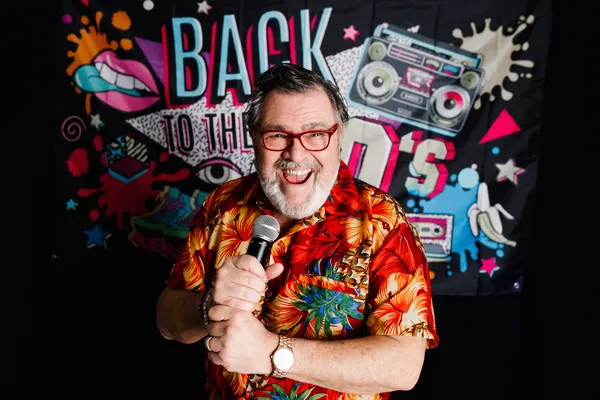

Still Pushing Pineapples opens with the famous Mick Jagger quote “I’d rather be dead that singing Satisfaction when I’m 45.” How well can any of us really anticipate who we will be 20 years in the future? The Stones kept touring to make money but also, at least sometimes, because they enjoyed it. The same is true of the man best known for Agadoo.
Kim Hopkins’ investigation into the fate of Eighties popsters Black Lace doubles as a touching portrait of family life in North West England. At the centre of it is taxi driver Dene Michael Betteridge, who sang backing vocals for the band on early hits like Superman and took over the role of lead singer when original star Colin Gibb was caught up in a scandal. The fact that that scandal involved a relationship with a child is left out here, and the same applies to other awkward details like the time that Dene spent in prison for benefit fraud. The focus is on the present day, in which Dene’s life revolves around caring for his elderly mother, Anne; navigating a relationship with a new girlfriend; and, still, performing.

Dene hits the nail on the head when he observes, part way through the film, that it’s been a while since there was a good party song in the charts. By ‘party song’ he seems to mean something that’s easy for anyone to sing along to, with actions to simplify dancing and with a generally silly theme. There is undoubtedly an appetite for this stuff, as one can see from the delighted reactions of crowds (admittedly mostly consisting of people over 60) in the various venues where he appears. Rather than a desperate has-been appearing on stages that are too big for him, he has become a club singer, enjoying a bit of banter with the crowd, making good use of his assortment of pineapple-themed shirts. A big guy with a beard, he doesn’t really look like a pop star, but then, Black Lace never really did.
Scattered reminiscences about the band are accompanied by snippets of their hits, though we never get a full song, which makes one wonder if there are copyright issues. There’s also a clip from Alan Clarke’s Rita, Sue And Bob Too, in which the band appears on stage at a social event, thankfully without Colin. Alongside this, we meet Dene’s girlfriend, who gets his face tattooed on her arm (alongside a pineapple) when they’ve been together for only two months; and we follow the couple as they take his mum on a last trip to Benidorm in a rented camper van.
Hopkins captures a wealth of important moments in the singer’s life, from a difficult conversation with his manager to a Christmas trip to Blackpool with his mum, and the time when he takes her to watch the coronation of King Charles on a big screen with a small crowd of elderly people holding tiny plastic flags. We learn of her passion for bread an butter pudding, and see them getting ice cream with his girlfriend’s kids, including a small girl who says it’s time that he sang something less boring. He has a better voice than the Black Lace songs require, and likes the idea of getting to use it more, but without the Black Lace branding, who is he? Even his number plate is AGO4 DOO. When he goes to ComicCon to sign autographs, a dalek wanders by, singing what voters decreed to be the worst song of the Eighties.
Full of engaging material yet sometimes stretched a little too thin, the film is less pop biopic, more a meditation on ageing, and over time it takes on an increasingly melancholic tone. Dene still dreams of writing another hit song. Perhaps one day it will happen. Until then he’s just an average Northern bloke, dressed as a pineapple, crooning in the dark.
Reviewed on: 28 Nov 2025




Director: Kim Hopkins
Writer: Kim Hopkins
Starring: Dene Michael Betteridge, Anne Betteridge
Year: 2025
Runtime: 92 minutes
Country: UK
Search database:
